Leadership That Makes Room for Others

Kristin Wagonblott • July 10, 2026

In an episode of the Executive Alliance Podcast, host Rebecca Snyder speaks with Krista Crawford about the value of self-awareness, lifelong learning and creating space for other people to lead. Drawing on a career spanning banking, human resources, teaching and executive peer-group facilitation, Crawford explores how leadership evolves—and why effective leaders do not need to have every answer. 


Krista Crawford chairs a Vistage peer advisory group for CEOs and serves as a co-chair of Executive Alliance’s mentoring program. Earlier in her career, she held leadership roles in banking and human resources, including at a sheet metal fabrication company. She earned a doctorate focused on cultural intelligence and taught for 15 years at Virginia Tech and Champlain College. Her work centers on learning, connection and helping leaders solve problems together. 


Listen to the Executive Alliance Podcast: Spotify podcast 


A career built through curiosity 

Crawford describes her current Vistage role as a convergence of earlier experiences. She began in banking after graduating during a recession, moved into senior HR positions and later pursued doctoral study while caring for her mother. Teaching followed, then an unexpected introduction to Vistage. Rather than presenting these moves as a fixed career plan, she calls her professional life a series of iterations, each building on skills from the last. 


That willingness to change direction is not the opposite of focus. For Crawford, it reflects an ongoing commitment to learning. When she lacked confidence in an area, she sought feedback, read books, took classes or found ways to assess her abilities. Her story offers a practical picture of professional growth: experience matters, but curiosity keeps experience useful. 


Ask better questions—and listen 

In her Vistage groups, CEOs leave daily operations behind for a day each month to work on their businesses. Participants bring difficult issues, hear clarifying questions and consider suggestions from peers. Crawford uses a related approach in Executive Alliance mentoring sessions, where participants bring their “messes” to the group. 


The framework begins with a concise description of the problem rather than a long account of every detail. Others ask questions before offering ideas, and the person facing the challenge decides what action, if any, to take. Crawford emphasizes that asking questions is only half the work: leaders must listen to the answers instead of mentally preparing their next insight. The facilitator’s job, she says, is often to step back so the group can help itself. 


Lead so others can act 

Crawford challenges the assumption that strong leadership means being indispensable. When every decision depends on the person at the top, the organization becomes vulnerable. Leaders should develop people who can make decisions, delegate effectively and keep work moving even when the CEO is absent. That does not mean abandoning a leadership role; it means creating room for vision and longer-term thinking. 


This principle also starts with the leader’s own behavior. Crawford argues that people must learn to lead themselves before they can lead others well. Self-awareness, follow-through and attention to how others experience them are not secondary to technical skills. They shape whether colleagues can trust their leadership. 


Use your voice, and make space for more voices 

Crawford credits her family with giving her a voice from childhood, and candid feedback from early supervisors with helping her strengthen it. She urges women to protect their participation in meetings rather than automatically volunteering for tasks such as taking notes. Being helpful should not mean surrendering the opportunity to contribute ideas. 


She also advocates intentionally examining who is missing from a leadership table. In one exercise, participants look at an illustration of a boardroom and ask which perspectives, industries or experiences are absent. Mentoring is another way to expand that table by helping emerging leaders clarify their purpose, recognize strengths and advocate for themselves and others. 


Make feedback part of the work 

When criticism is surprising, Crawford recommends responding with curiosity: ask for examples and more information before deciding what to change. She favors frequent, short check-ins over saving concerns for an annual review. A simple conversation about progress, resources and support can surface issues while they are still manageable. 


Her reflections return to a consistent theme: leadership is not a finished identity. It is a practice of listening, learning, adapting and giving other people the confidence to act. Crawford’s own next chapter includes teaching again through Vistage presentations, alongside a deliberate commitment to time for travel, rest and life beyond work. 


This blog post was written with the assistance of AI. 


Other Articles
By Kristin Wagonblott • November 5, 2026
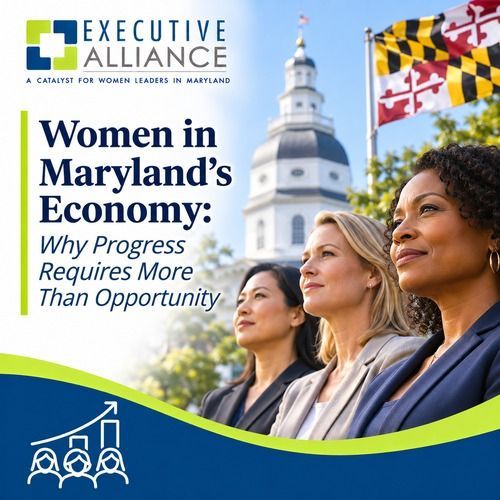
Women are essential to Maryland’s economic future, but persistent barriers continue to limit their participation, advancement, and financial security. In this episode of the Executive Alliance Podcast, host Rebecca Snyder speaks with Maryland Comptroller Brooke Lierman and Dani DiPietro of the Comptroller’s Office about a new report examining women’s experiences in Maryland’s economy. Their conversation explores the realities behind the data, the challenges facing women entrepreneurs, and opportunities for policymakers and business leaders to create meaningful change. Listen to the Executive Alliance Podcast on Spotify: https://open.spotify.com/show/033CPjpWSpbNiaBIlljxh1?si=56fdebfb23444ca2 Understanding the Economic Cost of Inequality Women make up more than 51% of Maryland’s population. As Comptroller Brooke Lierman explains, the state cannot reach its full economic potential if women are unable to reach theirs. That understanding prompted the Comptroller’s Office to examine how women participate in Maryland’s economy and what continues to hold them back. The report builds on earlier research into childcare, housing, immigration, and other factors shaping the state’s economic health. Rather than relying exclusively on statistics, the research team spoke with nearly 200 women through seven roundtable discussions across Maryland. For DiPietro, combining quantitative research with lived experience is essential: data identifies disparities, while conversations help explain why they persist. The Participation Gap Is More Complicated Than It Appears One central finding is an eight-percentage-point gap between men’s and women’s labor force participation in Maryland. That gap becomes much larger among certain groups: 32 percentage points among people with limited English proficiency, 23 among those without a high school diploma, and 21 among married adults with young children. These differences suggest targeted responses rather than a single statewide solution. DiPietro highlighted English-language education, recognition of credentials earned abroad, career and technical education, flexible workplace policies, and paid family and medical leave. The goal is not to push every woman into the workforce; it is to remove barriers for women who want to work but cannot find opportunities that fit their circumstances. When Entrepreneurship Becomes a Necessity One of the conversation’s most revealing themes concerns women-owned businesses. Women have been starting businesses at a faster rate than men since the pandemic. On the surface, that sounds encouraging. But DiPietro cautions that the motivations deserve closer examination. Some women pursue entrepreneurship because traditional workplaces have failed to provide advancement, flexibility, or stability. Others have experienced layoffs or discrimination. A roundtable participant described starting a business out of necessity because the workforce was not built for someone in her circumstances to get ahead. Entrepreneurship can offer autonomy, but it also introduces risks. Women may sacrifice employer-sponsored health insurance, retirement benefits, and predictable income. Meanwhile, access to capital remains a substantial obstacle. DiPietro discussed evidence of lower loan approval rates and greater difficulty attracting investors, even among women with strong credit and repayment records. These challenges influence the types of businesses women establish. Without adequate capital, women may be less able to enter capital-intensive industries with opportunities to scale. DiPietro noted that women are more likely to operate businesses without employees. Starting a business because an opportunity is compelling is different from starting one because other opportunities have disappeared. Progress Requires Shared Responsibility Despite the difficult findings, Lierman and DiPietro emphasized Maryland’s strengths. The state ranks among the top ten for women’s labor force participation and has one of the smaller gender wage gaps nationally. Yet those achievements do not eliminate the need for progress. Lierman stressed that no single law can address every barrier. Government policy, public investment, corporate leadership, and individual action all have roles to play. She pointed to corporate board diversity reporting as an example of how transparency can encourage accountability, even when legislation does not directly determine who serves on boards. For Executive Alliance, the conversation reinforces the importance of examining not only how women develop as leaders, but whether the systems surrounding them allow their leadership to flourish. Maryland has talented, educated, entrepreneurial women ready to contribute. The challenge is ensuring that economic structures support their ambitions rather than constrain their choices. The report provides a foundation; what happens next depends on leaders using its findings to turn understanding into action. About the Guests Brooke Lierman is Maryland’s Comptroller and the first woman elected to the position. She previously served in the Maryland General Assembly. In the podcast, she discusses the Comptroller’s Office’s efforts to use economic research to inform public policy and advance a more equitable, resilient, and prosperous Maryland. She also brings a personal perspective as a working mother and caregiver navigating many of the challenges discussed in the report. Dani DiPietro helps lead policy research in the Maryland Comptroller’s Office, developing comprehensive reports about the state’s economic challenges and opportunities. Her work combines quantitative analysis with conversations involving Maryland residents and stakeholders. In the podcast, she describes research on housing, childcare, immigration, and women’s economic participation, emphasizing the value of connecting statewide data with lived experience to help policymakers understand barriers and identify possible solutions. This blog post was written with the assistance of AI.
By Kristin Wagonblott • October 30, 2026
Getting a seat at the leadership table is an achievement. Knowing how to use that seat—and making sure others are heard—is another kind of responsibility. In this episode of the Executive Alliance Podcast, host Rebecca Snyder speaks with Tamla Olivier, president and CEO of Baltimore Gas and Electric (BGE), about self-advocacy, the pressure to prove oneself, and the choices leaders make to create more inclusive organizations. Her experiences offer a candid look at what it takes not simply to advance, but to influence the room once there. Listen to the Executive Alliance Podcast on Spotify: https://open.spotify.com/show/033CPjpWSpbNiaBIlljxh1?si=56fdebfb23444ca2 Hard Work Is Necessary—but Not Sufficient Early in her career at T. Rowe Price, Olivier expected that strong performance would speak for itself. When a leadership position opened, she waited to be approached. Instead, the opportunity was offered first to a peer. Although Olivier ultimately received the role after that person declined it, the experience changed her understanding of career development. She had been taught to work hard, build relationships, and deliver results. Those habits mattered, but they did not communicate her aspirations. Olivier now emphasizes telling decision-makers what role one wants, explaining why one is ready, and asking what additional experience would strengthen a future candidacy. Self-advocacy, in her telling, is not a substitute for performance; it is how capable people help others see where they want to go. Finding a Leadership Style That Fits Olivier spent more than 25 years in human resources before moving into broader business leadership. She describes HR as both strategic and deeply human: employees bring different experiences, pressures, and strengths to work, and leaders cannot expect everyone to respond to the same approach. That perspective also shaped her own development. Earlier in her career, she often modeled herself on the predominantly male leaders around her. Over time, she learned to bring her own approach while remaining open to feedback. One colleague pointed out that her facial expressions could discourage participation during meetings. Rather than abandon her directness, she asked a peer to help her recognize the behavior and practiced listening and asking more questions. Importantly, Olivier distinguishes useful feedback from unequal expectations. She also recalls being told to calm down for expressing views with a passion that was accepted from male colleagues. Effective leadership, she suggests, requires both personal reflection and a willingness to recognize double standards. The Burden of Having to Prove You Belong Olivier speaks frankly about the added pressure she experiences as a Black woman in executive leadership. Even after earning the CEO role, she feels responsible for demonstrating every day to employees, customers, regulators, and other stakeholders that she deserves the position. She recalls a colleague suggesting that an earlier move from HR into business operations was viewed by some as a diversity rotation. Her response was to ask what he had said when others made that claim. The silence was revealing. The experience reinforced a difficult lesson: even people regarded as allies may fail to challenge assumptions about who has earned an opportunity. Making the Table Work for Everyone For Olivier, inclusion is more than an invitation to attend. She remembers meetings where junior men confidently occupied seats at the main table while accomplished women sat along the edges. She encouraged one talented colleague to move into the discussion, then challenged her assumption that she needed permission to belong there. Olivier also pays attention to whose contributions are overlooked. When someone struggles to enter a conversation, she invites that person to speak; when a useful idea is dismissed, she names its value. One employee later told her it was the first time in 17 years that anyone had affirmed her contribution in a meeting. The moment underscored how much influence leaders exercise through seemingly small choices. Her experience on corporate boards reinforces the same theme. Olivier describes evaluating whether Century Aluminum was genuinely interested in evolving its leadership and governance, rather than judging the opportunity solely by its existing composition. She values boards whose members contribute different perspectives and actively support the organization. The message is both individual and institutional: women need to articulate their ambitions and claim their place, while leaders must examine who is heard, sponsored, and considered for opportunity. A seat matters most when it comes with a voice—and when its occupant helps open the conversation to others. About the Guest Tamla Olivier is president and chief executive officer of Baltimore Gas and Electric, a role she assumed in 2025. Her career includes more than 25 years in human resources and senior leadership positions at BGE, Constellation, BGE Home, and Pepco. She also serves on corporate boards, including Century Aluminum. Her leadership experience spans talent development, business operations, organizational strategy, and governance. This blog post was written with the assistance of AI.
By Kristin Wagonblott • October 30, 2026
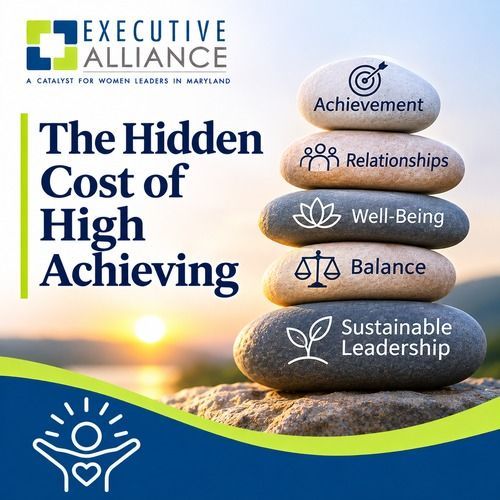
Achievement can open doors for women leaders. But when the drive to excel becomes an expectation to do everything, the very strength that advances a career can begin to undermine well-being. In this episode of the Executive Alliance Podcast, host Rebecca Snyder speaks with Linda Roszak Burton, a former Executive Alliance president, executive coach and board-certified health and well-being coach, about why leadership development must consider the whole person, not only professional performance. Listen to the Executive Alliance Podcast on Spotify: https://open.spotify.com/show/033CPjpWSpbNiaBIlljxh1?si=56fdebfb23444ca2 A blind spot in leadership development Burton began rethinking her coaching after the pandemic, when executive clients described the strain of supporting struggling teams while navigating their own difficulties. Traditional leadership programs teach strategy, delegation, decision-making and executive presence, she observed, but often pay less attention to the capacity leaders need to sustain those skills under pressure. She calls this a blind spot rather than a failure of leadership development. Exhaustion can erode decision quality, strain relationships and affect organizational results. For women, Burton sees an additional challenge: the emotional and practical responsibilities they often carry at work and at home. Supporting their continued leadership, she argues, means addressing physical, mental and emotional well-being alongside executive skills. When strengths work against us A central idea in the conversation is that strengths can become liabilities when overused. Drive and ambition help women reach senior positions, yet an unrelenting need to achieve may crowd out relationships, reflection and health. Burton distinguishes between a productive passion for work and an obsessive attachment that leaves little room for anything else. Her coaching starts with values, strengths, mindset and goals, including a candid look at obstacles. She also asks leaders to examine the stories they tell themselves. A woman may enter a meeting fully prepared while privately questioning whether she belongs there. That inner dialogue can shape how she presents her accomplishments. Burton encourages clients to decide how they want to feel after a meeting, then consider what mindset will help them show up that way. Small practices, sustained change The solutions Burton describes are deliberately practical. She schedules walks on her calendar and makes a backup plan for days when the original time no longer works. She also relies on coaches and peers for accountability. When a routine slips, the response is not harsh self-criticism but self-compassion and a decision about the next manageable step. One client placed a small red dot near the ignition of a car as a reminder to sit quietly for two minutes before driving. That pause could be used for breathing, gratitude or simply settling the mind. Burton asks a related question about an unexpected fifteen minutes in the day: what could a leader do with that time that would help her show up better? The emphasis is on practices that can be repeated, adapted and sustained. Gratitude beyond the thank-you note Burton’s interest in gratitude is both professional and personal. After losing her younger sister to breast cancer, she began journaling through grief. Later, studying gratitude helped her recognize the people, strengths and sources of support that had carried her through a painful period. She does not suggest that gratitude eliminates grief; rather, it helped her see her experience in a different light. In organizations, she urges leaders to move beyond generic praise. Meaningful appreciation identifies a specific action, explains why it mattered and recognizes the effort or sacrifice behind it. It also considers how each person prefers to be acknowledged. This attention can strengthen relationships and help teams recognize what worked, even during a difficult quarter, without pretending the difficulties did not exist. Leadership is not a solo endeavor Burton closes with a challenge especially relevant to Executive Alliance: women need sponsors who recognize their abilities and advocate for them when they are not in the room. They also need to sponsor one another, intentionally naming strengths and opening doors. As she puts it, the pressure is too great to carry alone. The broader lesson is not to abandon ambition. It is to make achievement sustainable through self-knowledge, realistic habits, supportive relationships and workplaces that value the whole leader. The question is not only what women can accomplish, but what will help them continue to thrive while accomplishing it. About Linda Roszak Burton Linda Roszak Burton is a former president and longtime member of Executive Alliance, an executive coach and a board-certified health and well-being coach. Her work draws on positive psychology, strengths, gratitude, resilience and stress management. She has written a gratitude journal and workbook, and she incorporates research and practical well-being strategies into her coaching of leaders and organizations. This blog post was written with the assistance of AI.
Show More