Beyond the Legislative Session: What It Takes to Advance Women in Maryland
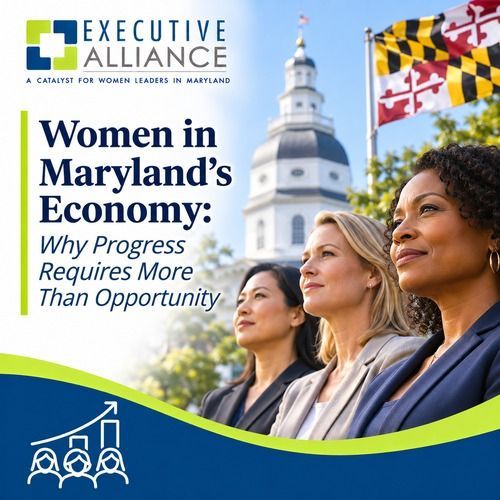
Maryland has made meaningful strides in advancing women’s leadership, but progress is neither automatic nor evenly shared. In an episode of the Executive Alliance Podcast, host Rebecca Snyder speaks with Ariana Kelly, executive director of the Maryland Commission for Women and a former state legislator, about the 2026 legislative session, the economic realities facing women, and the long-term work required to turn policy into opportunity.
Kelly describes a commission with a broad mandate: ensuring that state government considers women’s needs, from health and safety to professional advancement and economic security. Its work begins by listening to women across Maryland, then moves through research, policy recommendations, legislation, implementation, and communication. For Kelly, those stages belong to one continuous process.
Listen to the episode: https://open.spotify.com/show/033CPjpWSpbNiaBIlljxh1?si=56fdebfb23444ca2
Economic opportunity depends on the care economy
Kelly’s commitment to economic security is personal. Her mother, a teenage parent, relied on subsidized child care to pursue education and move her family out of poverty. Years later, Kelly was stunned to discover that Maryland’s child care subsidy program had fallen near the bottom of national rankings. That experience reinforced a lesson she has carried throughout her career: a state’s progressive reputation does not guarantee that its policies keep pace with women’s lives.
Child care remains a central concern. Families struggle with costs, while the predominantly female child care workforce also deserves sustainable wages. Kelly points out that when child care costs exceed a parent’s take-home pay, leaving the workforce can become the practical choice. The consequences extend beyond immediate income to career advancement and retirement security.
The same challenge appears in elder care and family caregiving. Kelly argues that women’s growing participation in paid employment was never matched by a system that fully recognizes the value of their unpaid labor. The commission is exploring longer-term approaches to supporting caregivers and those who need care, recognizing that meaningful reform requires research, partnerships, funding, and persistence.
A legislative win is only the beginning
Kelly highlights menopause legislation from the 2026 session as an example of how health policy intersects with economic security. The legislation addresses insurance coverage for menopause treatment and encourages greater clinical training. Women had reported difficulty getting symptoms recognized and receiving appropriate care; those barriers can affect their ability to work and earn at a critical career stage.
Passing legislation, however, does not complete the work. Kelly emphasizes the implementation partnerships, professional education, and continuing policy research needed to make changes meaningful. The commission also plans to build on research about caregiving and retirement readiness, with particular attention to the financial insecurity women can face later in life.
Representation changes what is possible
The conversation also turns to who makes policy. Kelly recalls watching Maryland’s House of Delegates become more representative during her 14 years in office. As more women gained leadership positions, she saw issues once considered marginal become more viable and younger women see themselves reflected in public leadership.
She contrasts that progress with the underrepresentation of women in the state Senate. When only a few women serve on a committee, each may be expected to represent the experiences of all women—an impossible burden given women’s varied backgrounds and priorities. More diverse representation, Kelly argues, changes both whose voices are heard and which proposals have a path forward.
Leadership requires credibility and collaboration
Kelly also shares a pragmatic lesson from a mentor: build expertise, make meaningful contributions to the institution, and earn the influence needed to advance the issues that matter most. She developed deep knowledge of health care and insurance policy, which helped her build the credibility and relationships to pursue her priorities.
Today, her work is less about individual legislative authority and more about convening people around shared goals. She describes listening to commissioners, advocates, agency partners, and experts while remaining strategic about outcomes. The message for leaders is clear: lasting change takes both a commitment to the mission and the discipline to build a workable path toward it.
About Ariana Kelly
Ariana Kelly is executive director of the Maryland Commission for Women, where she works with appointed commissioners and staff to advance policies supporting women across the state. She previously served 14 years in the Maryland General Assembly representing District 16. Earlier in her career, she worked in advocacy and as a television producer for the PBS program To the Contrary, which focused on women’s issues.
This blog post was written with the assistance of AI.
Other Articles